
The short answer
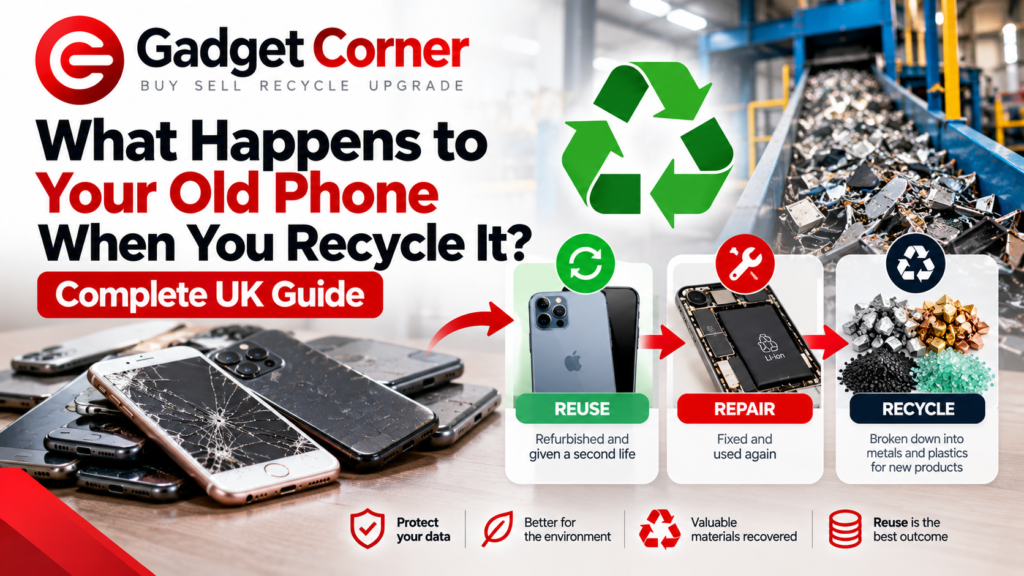
When you recycle an old phone, it is collected, checked, and then either reused or broken down. Anything that cannot be reused is shredded and separated into materials such as metals and plastics, which can go back into making new products. The battery is handled separately, because a damaged lithium battery can start a fire.
That is the tidy version. The more useful version is about what happens before and after the recycling bin, and what you can do so your phone ends up in the best possible place. This guide covers all of it, in plain English, with sources we have checked.
Why so many old phones sit in drawers
Almost everyone has one. A phone that still switches on, or doesn’t, sitting at the back of a drawer “just in case”.
The UK charity Material Focus has put numbers on the problem. In a media release from October 2021, based on research with 2,000 UK adults, it reported that only a third of UK adults had recycled their unwanted electricals over the previous year. It also cited an earlier report that found 527 million items hoarded in UK homes. These figures are a few years old now, so treat them as a snapshot rather than today’s total, but the picture will be familiar to most people. You can read the Material Focus release here.
The reasons are easy to understand. People worry about their data. They think the phone might be worth something. They mean to sort it out at the weekend. Meanwhile the phone loses value every month it sits there, and the battery ages in the drawer.
Reuse comes before recycling
Recycling is a good outcome, but it is not the best one. If a phone still works, or can be repaired cheaply, giving it a second life usually makes better use of what has already been made than breaking it down and building a new one from scratch.
That is why the sensible order is:
- Repair it if the fault is small and the phone is worth keeping.
- Sell it or pass it on if it still works and somebody could use it.
- Recycle it if it is beyond sensible repair and has no resale value.
The Recycle Your Electricals campaign says the same thing on its website. It points out that you can repair, donate or sell electricals as well as recycle them, and that anything with a plug, battery or cable can be recycled when it reaches the end of its life. You can see this on Recycle Your Electricals.
If you are unsure which category your phone falls into, we have written about exactly that decision in our guide to whether your phone is worth fixing or replacing. And if the screen is the only problem, read whether a cracked phone is worth repairing before you write it off.
What happens to a phone at a recycling plant
Exact methods vary between recyclers, and no two plants work in precisely the same way. But the general route looks like this.
1. Collection. Your phone is dropped at a recycling centre, handed in at a shop, sent through a postal scheme, or collected from your home by some councils. It is then taken to a processing site.
2. Sorting and checking. Devices are sorted. Some firms inspect phones to see whether they can be reused or refurbished instead. Apple, for example, says on its trade-in page that devices are inspected and assessed for reuse or recycling, and that a device that is not eligible for credit is recycled for free. Details are on Apple’s UK trade-in page.
3. Battery removal. Batteries need to come out and be handled on their own route, for the safety reasons covered below.
4. Shredding and separating. According to RecycleNow, as reported by Which?, collected electrical waste is shredded and separated into ferrous metals, non-ferrous metals and plastics. Which? also notes that cables often contain copper and aluminium, which can be turned into new products. The full explanation is in the Which? guide to recycling electrical items.
5. Back into use. The separated materials are sold on to be made into new things. Recycle Your Electricals says about 75% of the materials in old electricals can be recycled into new products, including playgrounds, life-saving equipment and new electricals.
Notice what is not on that list. A recycled phone does not simply get cleaned up and handed to someone else. If it is reused, that is a separate route from recycling, and it usually involves a refurbisher or a buyer rather than a shredder.

Why the battery needs special care
This is the part we would most like people to take seriously, because it is a safety issue and not just an environmental one.
Phones contain lithium batteries. When they are crushed, punctured or damaged, they can overheat and ignite. Recycle Your Electricals warns that hidden batteries inside electricals can spark dangerous fires when they are crushed in bin lorries and recycling centres, and says that you should never put batteries in the bin.
A few practical rules:
- Never put a phone in your general waste or your normal recycling bin. Apple’s website also states that electronics and batteries must not go in household waste.
- Do not keep a swollen or damaged battery in a drawer. If the back of the phone is bulging, it needs handling by a professional. Bring it to us or to a proper recycling point rather than trying to open it yourself.
- If you post a device for recycling, follow the scheme’s rules. Apple’s postal guidance, for example, says not to send loose batteries, to discharge to below 30%, never to send damaged or swollen batteries, and to send only one device per box.
If your phone has a bulging battery or a battery that drains in minutes, that is also a good reason to ask about a battery replacement. A fresh battery can extend the life of a phone that is otherwise fine.
Your data does not disappear on its own
Recycling a phone does not guarantee that the information on it is erased. Handing over a device that still holds your photos, messages and logged-in accounts is a risk, whoever you give it to.
Before any phone leaves your hands, whether it is going to be sold, recycled or given away, you should:
- Back up anything you want to keep.
- Sign out of your Apple Account or Google account.
- Switch off Find My or Google’s device lock.
- Use the built-in factory reset or erase option.
- Take out the SIM card and any memory card.
This is the same advice given in the National Cyber Security Centre’s guidance on buying and selling second-hand devices. Apple also tells people to back up and remove personal data before sending a device for recycling, and notes that you lose access to the device once it has been recycled.
A phone that will not turn on is harder, because you cannot run the reset. If that is your situation, bring it in and ask. We can talk you through the options before it goes anywhere.
Where to recycle an old phone in Oldham and Greater Manchester
You have several choices, and the right one depends on the condition of the phone.
Your local household waste and recycling centre. Oldham Council lists the Arkwright Street Recycling Centre in Oldham, and says its centres are free to use for household waste and recycling. The council page does not give details on electrical items, so check the Recycle for Greater Manchester information or contact the council before you go. You can see the Oldham Council recycling centres page for current information.
A recycling point near you. The Recycle Your Electricals website has a postcode locator covering almost 30,000 drop-off points, including recycling centres, shops, charities and community sites. It only accepts UK postcodes.
A retailer. Some shops take back old electricals, but the rules differ. Which? reports, for example, that Argos recycles electronics in store if it sells a similar item and you bought a replacement within the last 28 days, and that Currys offers free in-store recycling. Their terms can change, so check with the shop first.
A manufacturer scheme. Apple says that if a device is not eligible for credit, it will recycle it for free.
Council kerbside collection. Some councils collect small electricals and batteries from your doorstep. Which? suggests putting them in a carrier bag beside your bin on collection day, but this depends on your council, so check before you leave anything out.
A local shop that buys and repairs phones. If you are not sure whether your phone is worth anything, it is worth asking a repair shop before you recycle it. A phone that looks finished to you can sometimes be fixed, or sold. If it genuinely cannot be, we will tell you so.
Sell, repair or recycle: how to decide
Here is a quick way to choose.
Your phone works and is under a few years old. Sell it. Someone else will use it and you get paid. Our guide to how much your old iPhone is worth in 2026 is a useful starting point, and our We Buy Your Tech page explains how selling to us works.
Your phone works but the screen or battery is the problem. Get it looked at. Our mobile phone repairs page covers what we fix.
Your phone is dead, damaged or very old. Ask before you bin it or recycle it. If it can be saved, we will say so. If it cannot, recycling is the right end for it, and you know where to take it.
You are upgrading and do not want the old one. Wipe it and sell it, or use a trade-in or a take-back scheme. Just do not let it go back in the drawer.
The worst outcome is the one that happens most often. The phone stays where it is, loses value, and nobody gets any use out of it.
Got an old phone and not sure what to do with it?
Bring it to the shop. We will check it, tell you honestly whether it is worth repairing or selling, and help you wipe it properly if you decide to let it go. No pressure and no obligation.
770 Oldham Road, Failsworth, Manchester M35 9FE
Phone: 0161 681 1111
Email: Gadgetcorner00@gmail.com
Open Monday to Saturday, 9am to 8:30pm. Closed Sunday.
Got a phone that still works? Get a cash offer through our We Buy Your Tech page.
Can I put my old phone in the bin?
No. Phones contain batteries and electronic parts that should not go in household waste. Apple’s website says electronics and batteries must not go in household waste, and Recycle Your Electricals warns that hidden batteries can start fires in bin lorries and recycling centres. Take it to a recycling point, a retailer that accepts it, or a shop that buys phones.
What actually happens to a recycled phone?
Recyclers sort devices, remove batteries, and shred what cannot be reused. The shredded material is separated into metals and plastics, which can be used to make new products. Methods vary between recyclers.
Does recycling a phone erase my data?
Do not rely on it. Wipe the phone yourself before it leaves your hands. Back up, sign out of your accounts, switch off Find My or Google’s device lock, then use the factory reset. The National Cyber Security Centre gives the same advice.
Is it better to sell a phone than recycle it?
If the phone still works, yes. Selling keeps the phone in use and puts money in your pocket, and recycling is better saved for devices that cannot be repaired or sold. If you are not sure, ask a repair shop to have a look first.
Where can I recycle an old phone in Oldham?
Oldham Council lists the Arkwright Street Recycling Centre, and the Recycle Your Electricals postcode locator shows nearby drop-off points. Some retailers and manufacturers also take back old devices. Check each one’s current rules before you go.
Pingback: Sell My Old Tablet in Manchester: iPad and Android Cash Guide - Mobile Phone & laptop Repair Shop